Point or Flex?
Protecting Your Ankles in Middle Splits
Today’s blog post is going to be short and sweet because this is an easy question to answer!
Unless you have totally flat middle splits on the floor, I strongly recommend flexing your feet, and keeping the outside edge of your foot lifted. Why? Because that mimics the most “neutral” position of your ankle, so puts the least strain on your ligaments and connective tissue (while in a relatively “heavy” bodyweight-bearing position).
Our ankle and foot are actually connected by several joints and bones all held together by a series of ligaments, when our ankle is tilted to either side, this can put stress on the ligaments in the ankle joint:

Image Credit: OpenStax College, 919 Ankle Feet Joints, CC BY 3.0

Ankle Inversion. Too much can stress the ligaments on the outside of the ankle

Ankle Eversion. Too much can stress the ligaments on the inside of the ankle
Let’s take a look at several foot positions and how this impacts our ankle (and even knee) joint in a middle split:
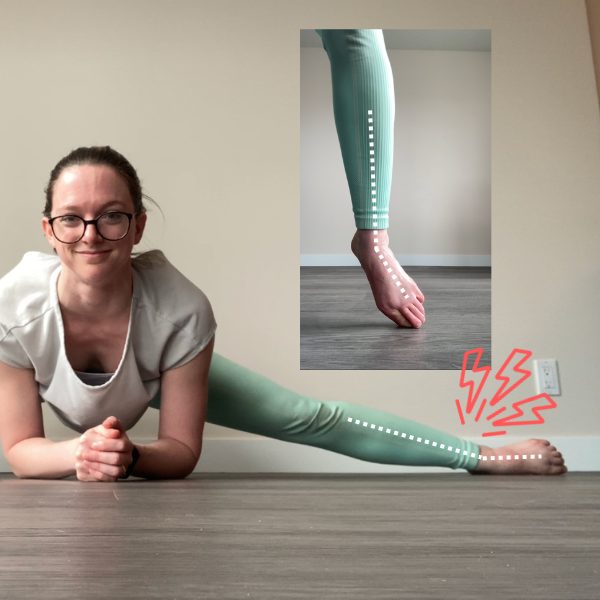

Toes Pointed
Unless your middle split is totally flat on the floor, pointing your toes and resting the inside edge of your foot on the floor requires you to wing your foot out to the side (aka ankle eversion), which can be uncomfortable, and put unecessary stress on the ligaments on the inside of your ankle. If you do have a completely-flat split, it’s fine to point your toes if you prefer.

Foot Flexed, Sole Flat on the Floor
Keeping the sole of your foot flat on the floor, which involves actively pressing the outside edge of your foot into the floor, causes the opposite strain: ankle inversion or a sickle-ing of the ankle. Unless your middle split is very far from flat, this can put too much strain in the ligaments in the outside of the ankle.

Foot Flexed, Sole Lifted (ideal)
This is the safest weight-bearing position because it keeps our ankle in a neutral position - the same position it’s in when we’re standing upright! So go ahead and let the outside edge of your foot lift off the ground, your ankles will thank you!


Foot Flexed, Toes Up
If you are practicing a middle split variation with the knees/thighs/feet rotated up towards the ceiling (and doing this intentionally and not accidentally), make sure you’re leading the hip rotation from the thigh bones and not over-twisting the ankle to rotate the toes up. It is possible to over-rotate the ankle by twisting at the knee (not ideal), so be careful to keep the front of your shin in line with the front of your thigh.
If this feels like an uncomfortable amount of pressure on your heel, feel free to place a pillow or rolled up yoga mat under your heel for some cushion.
Related Content
Recommended On-Demand Workshop

Note: this class is also a part of a 2-class bundle! If you also want to work on your front splits too, you should check out the “Starting Splits” Front & Middle Splits recording bundle.
Who this class recording is for:
This 45-minute class is intended for “beginner” to “begintermediate” students interested in working on their middle splits and straddles. For more intermediate/advanced students who are 3 inches or closer to the ground in their middle splits, I suggest you check out the 60-minute Middle Splits (Box Splits) workshop instead which has even more active flexibility drills in a longer class format. This workshop is a better fit for students who’s hips are 4 inches or higher away from the floor when doing a middle split.
Even if you are a super beginner and can’t touch your toes, this video has stretches and modifications for a variety of levels.
What this class includes:
A quick full-body warm-up to get you ready to stretch
Active flexibility exercises focusing on the two main muscles groups needed for middle splits and straddle pancakes: adductors (inner thighs) and hamstrings (with a healthy dose of glute and hip flexor strengthening for support!)
A full 45-minute stretching routine you can follow 1-3 days per week to work on your middle splits (due to the amount of strengthening involved, I don’t recommend doing this routine every day - your body will benefit more from rest days!)
Recommended props:
A chair (or a bench or low table)
Yoga blocks - totally optional, but they are a wonderful prop, especially if you’re a beginner. If you don’t have blocks, I recommend practicing next to a chair, your bed, or a wall so you can reach your hand out for balance if you need to
Note: Because of Squarespace’s file size limitations (which is what I use for this wonderful website!), upon purchase you will receive a PDF with a link to the recording. You can then stream the recording online from the private link.