What Is Sciatic Nerve Tension (and How Do I Fix It?)
What is Sciatic Nerve Tension?
(And How Do I Fix It?)
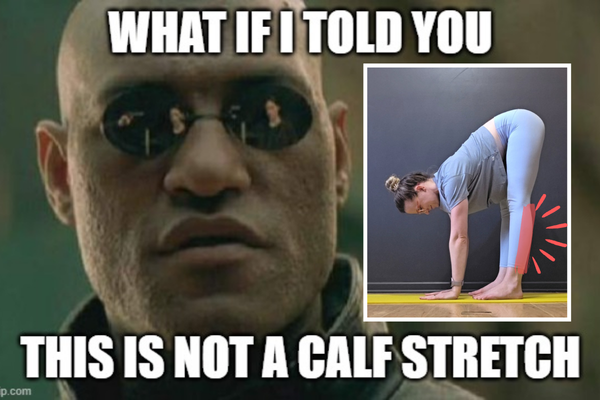
Spoiler alert: If you feel a CALF STRETCH in all your forward folds, there’s a good chance you’re actually feeling nerve tension, not a muscle stretch
This is a topic I wish I had learned about WAY earlier in my flexibility training journey, because it made such a huge difference in my leg flexibility (and I see the same thing happen with many students that I work with).
For the longest time, I just thought I had tight calves when it came to forward folds - because that’s where I often felt the most intense part of the stretch. So I did a ton of calf stretches, and would make some progress, but my calves always felt crazy tight. It wasn’t until years into my training I learned that what I was feeling was actually sciatic nerve tension and all of my “calf stretches” were probably doing more harm than good (at one point I even overdid it in a yoga class and had some mild zinging nerve-y pain for more than a week). Once I learned how to address the tension in my sciatic nerve (spoiler alert: did zero calf stretches), I was able to train a much deeper range of motion and make more progress in my hamstring flexibility than ever before.
This is something I love to teach students about because it’s not exactly “common knowledge” in the flexibility training space (yet!), and there are tons of flexy students out there (just like me) who have no idea that they have some sciatic nerve tension and should be training a bit differently to maximize their flexibility progress. Anecdotally speaking, when I have students do some of these nerve tests in a group class, slightly more than half test “positive” for having some sciatic nerve tension. It’s a surprisingly common phenomenon for being so rarely disucssed!
Obligatory Disclaimer: I am not a medical professional, and this is not medical advice - this blog post is for informational purposes only. This blog post is also only intended for students with no preexisting nerve issues. Especially if you have a preexsiting condition (ex. sciatica, a slipped/herniated disc, etc.), talk with your doctor before doing nerve glides and flexibility training to make sure it is safe and appropriate for your situation.
What Is Nerve Tension?
“Nerve tension” or “neural tension” is tension that limits the ability of our peripheral nerves (the nerves outside the brain and spinal cord) to slide and glide optimally, limiting their normal range of motion.
Unlike our muscles, our nerves are not designed to stretch, instead they are designed to slide back in forth through our soft tissue. But if there is something that is preventing the nerve from sliding (ex. a tight muscle putting pressure on the nerve and pinning it in place), then when we move it can start to be tugged into a state of tension, and since it can’t stretch like our muscles, our nervous system reacts to protect the nerve, contracting nearby muscles to limit the movement, or even potentially sending pain or other signals.
For nerve tension in our sciatic nerve, this can feel like:
a strong stretch or tightness in the bottom of the feet, calves, back of the knees, hamstrings, or low back (all places the sciatic nerve runs!) when doing forward folds or hamstring stretches
tingling in the bottom of the feet or toes in forward folds
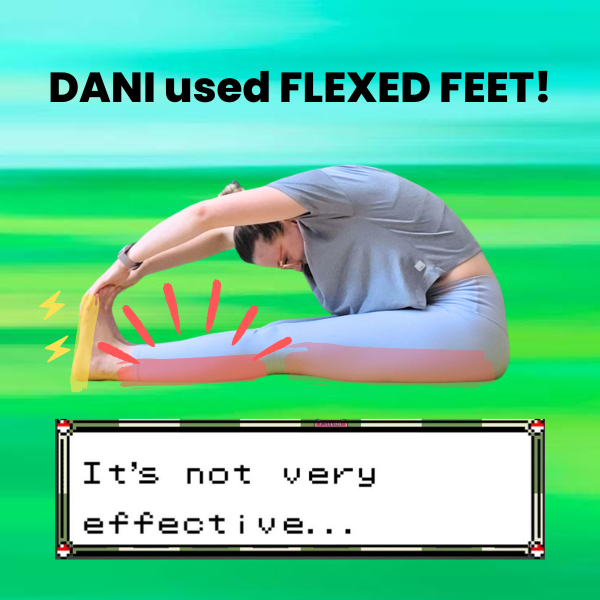
Sciatic nerve tension can be especially sneaky, because sometimes it feels just like a regular ol’ muscle stretch! But it’s important to understand if what you’re feeling is a “normal” muscle stretch or is it nerve tension because continuing to try to “stretch” an already-tense nerve can lead to even tighter muscles, or even injury. If the nerve is tugged too tight and is unable to slide to relieve the tension, our nervous system responds by tightening the nearby muscles to help restrict movement to prevent damaging the nerve. So at the very least, your stretching will be unproductive - or at the worst you could potentially damage the nerve.
How This Impacts our Flexibility Training
If you’re someone with sciatic nerve tension, and you’re trying to use your hands or a strap to pull yourself into a deeper stretch (because your hamstrings and calves feel tight!), this could actually backfire as your nerves send warning signals to the rest of your body that “hey, this isn’t safe, we can’t allow any deeper stretch here so we don’t get injured!” Then you wonder why you’re not making progress, so you try to do more passive stretching, your nerves get even crankier, and the cycle continues…
To optimize our flexibility training, we need to understand what’s limiting our range of motion so that we can tailor our training to address the underlying issue(s). While long passive stretch holds (ex. a relaxed standing forward fold) can be great for folks without nerve tension, they are typically counterproductive for folks with nerve tension - unless the nerve tension has been addressed.
So if nerve tension can “masquerade” as feeling like a normal muscle stretch, how do we know if the stretching sensation we are feeling is a “good” muscle stretch or a “uh oh, I should back off” sign of nerve tension? I’m so glad you asked…
How to Test if You Have Sciatic Nerve Tension
There are two different test we can do with our forward fold depending on where you typically “feel the stretch” in your forward folds.
Test #1: Hip Hinge Isolation
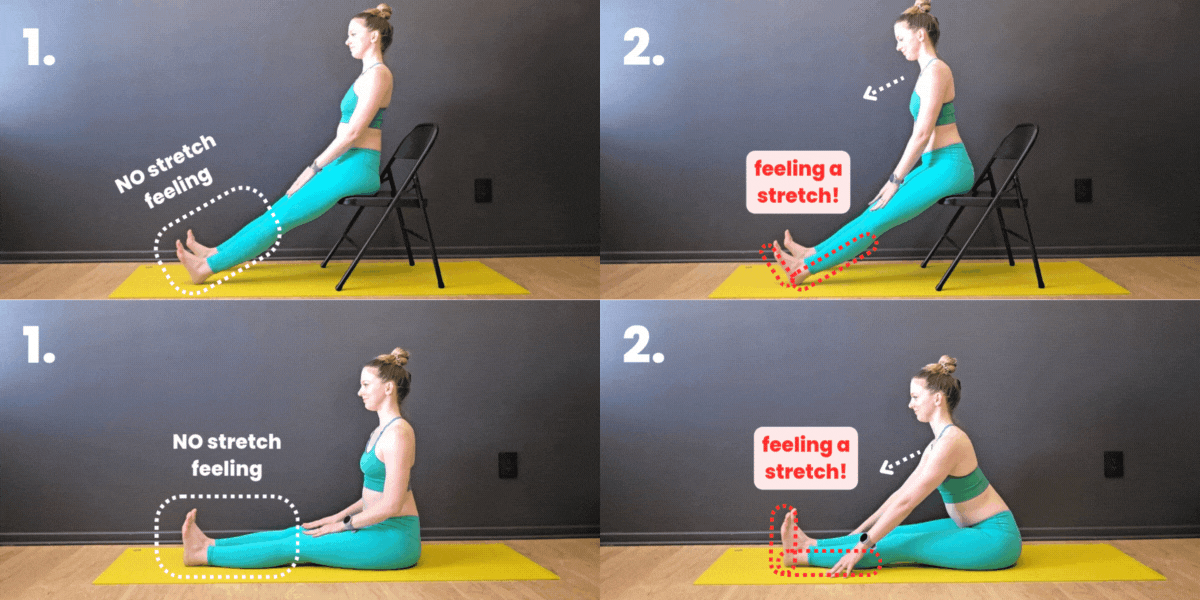
Start sitting upright with your back flat, legs extended out in front of you with feet comfortably flexed. This starting position should not feel like a stretch - so that means not over-flexing your feet (we don’t want to cause a calf stretch or feel any stretch underneath the knee), and possibly sitting on yoga blocks or a chair if you’re feeling a stretch in your hamstrings or back. This starting position should feel easy!
Now forward fold as far as you can, still keeping your feet flexed, knees straight, and back flat. What sensations do you feel? If you feel any: tingling in the soles of the feet or toes, burning in the calves, or a stretching sensation in the calves, and these sensations go away when you sit back upright (return to Position #1), these are all POSITIVE indications of likely nerve tension.
If your test was positive, there is no need to do the second test. If you didn’t feel any sensations in your feet or calves when you added the forward fold (perhaps you felt a hamstring stretch, or a stretch in the underside of your knee), then move on to the next test.
Test #2: Ankle Flex Isolation
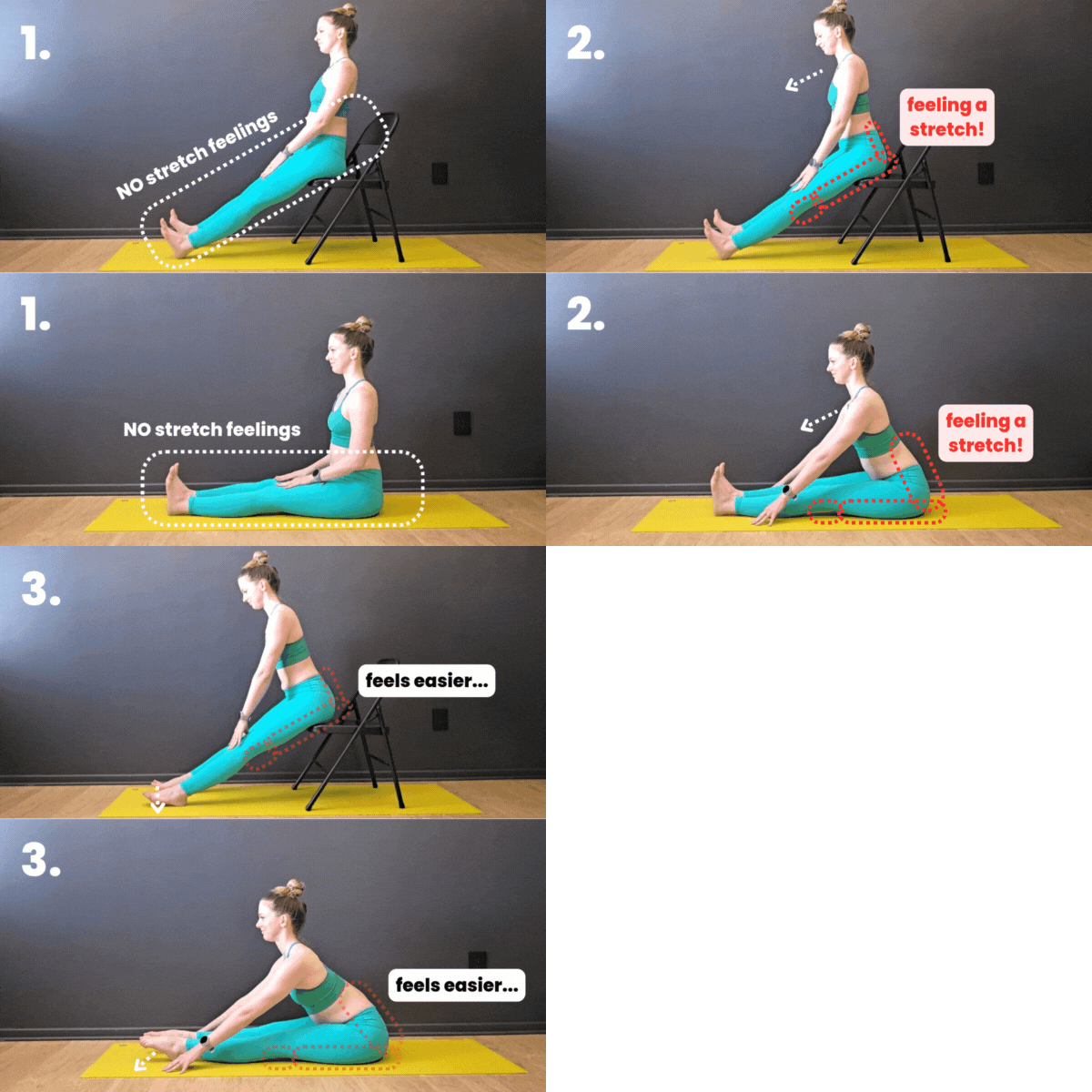
Start in the same seated forward fold as in the test above (back flat, knees straight, feet comfortably flexed). Make sure this position feels easy and you are not feeling a stretch!
Forward fold, keeping your back flat, knees straight, and feet flexed. What sensations do you feel? Do you feel a stretch (or tingling) in the knee, hamstrings, or low back? (If you feel a stretch in the calves or tingling in the feet, refer to the test above)
Now point your feet and notice do those sensations change? Feel free to try pointing and flexing your feet a couple of times to notice if those upper leg/back sensations change. If the sensations in your knee, hamstrings, or lower back get less intense, or if it feels like you can forward fold deeper when you point your toes, but those sensations get more intense/harder when you go back to flexing your feet (Position #2), that is a POSITIVE indication of likely nerve tension.
If the sensation you were feeling didn’t change when you pointed/flexed your feet, then odds are you’re just feeling a “regular” muscle stretch in your low back, or hamstrings (or where they attach under your knee) and you don’t have sciatic nerve tension.
For those of you who tested POSITIVE in either of the tests above, you now have a little bit more knowledge about one of the flexibility challenges you are facing! But it’s important to understand that nerve tension is just a piece of the flexibility puzzle. Having nerve tension does not mean you don’t also have tight/weak muscles. So in addition to addressing your nerve tension, you should also continue to work on your “regular” muscle-focused flexibility training.
Now let’s look at how you can adjust your flexibility training to help address your nerve tension, and avoid exacerbating it when doing deeper stretches/exercises.
How to Train with Sciatic Nerve Tension (Short Term “Fixes”)
First of all - nerve tension isn’t necessarily a “bad” thing - it’s a helpful adaptation our body does to protect ourselves from injury! But we do want to make sure we minimize any excessive nerve tension before doing deep stretches to help ensure that we can stretch and strengthen our muscles in their true end range without tugging too hard on the nerve(s). There are several things we can do to make our training more effective:
Add Nerve Glides to Your Warmup
The good news is that for most students with nerve tension, nerve glides can feel like a magical flexibility drill that instantly makes them more flexible. These are basically drills that help GENTLY tug on the nerve to help it get back to it’s sliding-and-gliding motion it’s meant to be using. Nerve glides are great to do as part of your warm up before doing your deeper flexibility work. There are lots of different variations of sciatic nerve glides, but I’ll include two below, and you can pick your favorite.
Important reminders about nerve glides:
Keep them gentle! Aim for like a 3-out-of-10 intensity of stretching sensation. We want to avoid intense stretching sensations in these drills, because that is a sign we may be tugging the nerve too hard (and they may respond by tightening up our muscles even more to protect themselves)
10-15 reps is all you need. More is not better! With drills like these, 10-15 per leg is all you really need (although if your nerve-y sensations come back later in your training session, you could add another set)
Test your nerve tension before and after. If the nerve glide is effective for you, you should notice an immediate improvement in lessening the intensity of the nerve-y sensations you were feeling pre-glide, or be able to forward fold slightly deeper than right before the glide. If you don’t notice an improvement, try a different nerve glide, or some of the other interventions in this post
Nerve glide effects are temporary. Nerve mobilizations are great for temporarily minimizing nerve tension during a training session so we can focus on deeper stretching work. For long-term reductions in neural tension, you’ll need to address the underlying cause of your nerve tension
Choose ONE of the following:
How To: Supine Sciatic Nerve Glide
This is my personal go-to I use every time I’m training my leg flexibility.
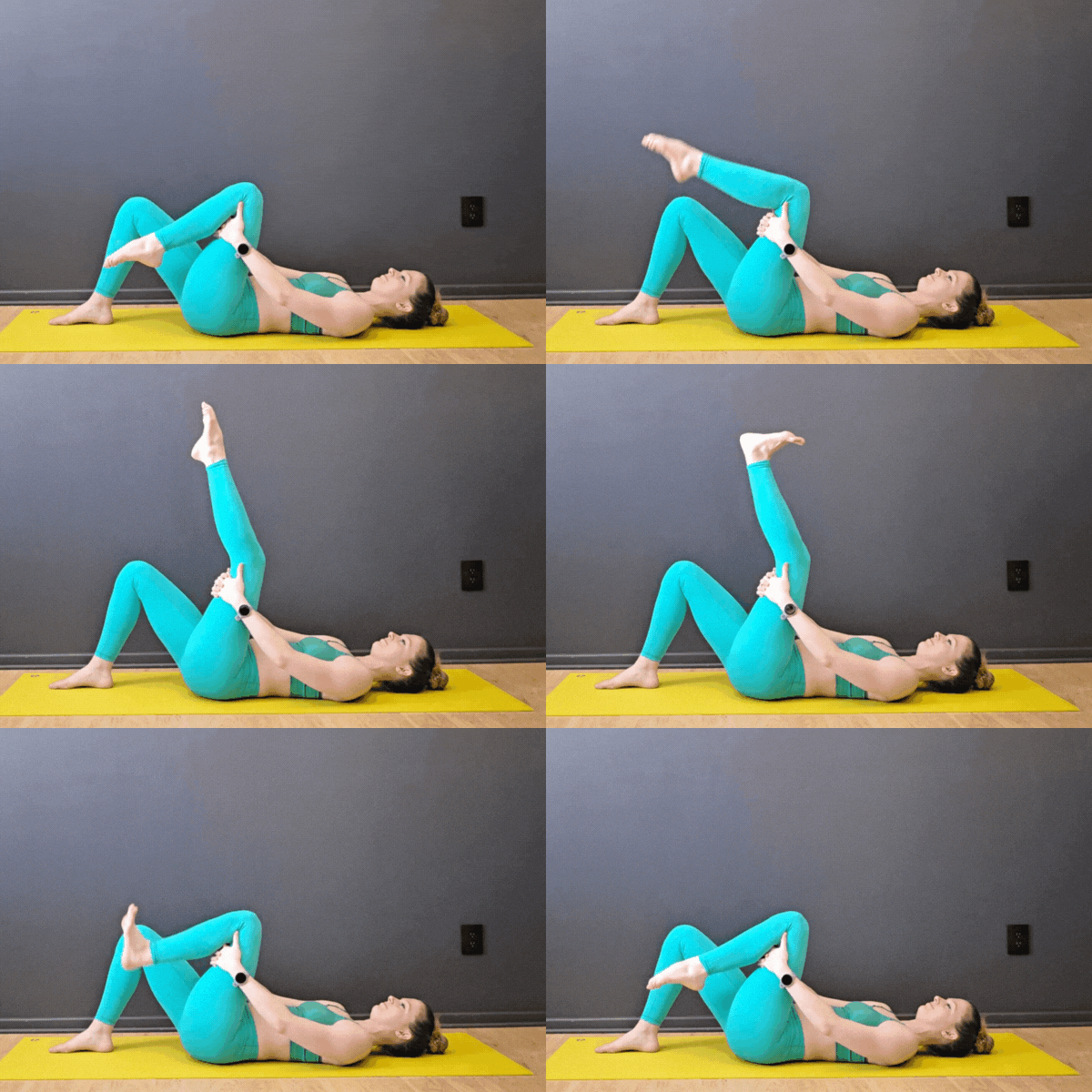
Start lying on your back with both knees bent. Grab onto the back of the left thigh for support, pulling the knee gently towards your chest, keeping the knee bent and foot pointed (the foot position matters!). Just pull the leg in as far as it will comfortably go without feeling a stretch or any tension - our goal here isn’t to get the knee all the way to our chest, just to elevate it slightly
Point. Start with your toes pointed
Lift. Keeping the toes pointed, start to straighten the knee - only go until you feel a mild stretch in the back of the left leg or knee - that may mean you don’t straighten the leg all the way. Remember, we’re keeping this gentle! It’s OK if you feel more tension in your quads (front of the thigh) as those muscles contract to partially straighten the knee.
Flex. Once you’ve found that (very gentle) stretch, flex the foot
Lower. Keeping the foot flexed, bend the knee, dropping the foot back towards the floor
Repeat for 10-15 reps on one side (point-then-lift-then-flex-then-lower), then switch sides.
The first couple of times you do this you can go slow to pay attention to the sensations, but eventually you can do these faster as you get more coordinated (as long as you’re keeping the sensations easy!).
How To: Seated Slump Nerve Glide
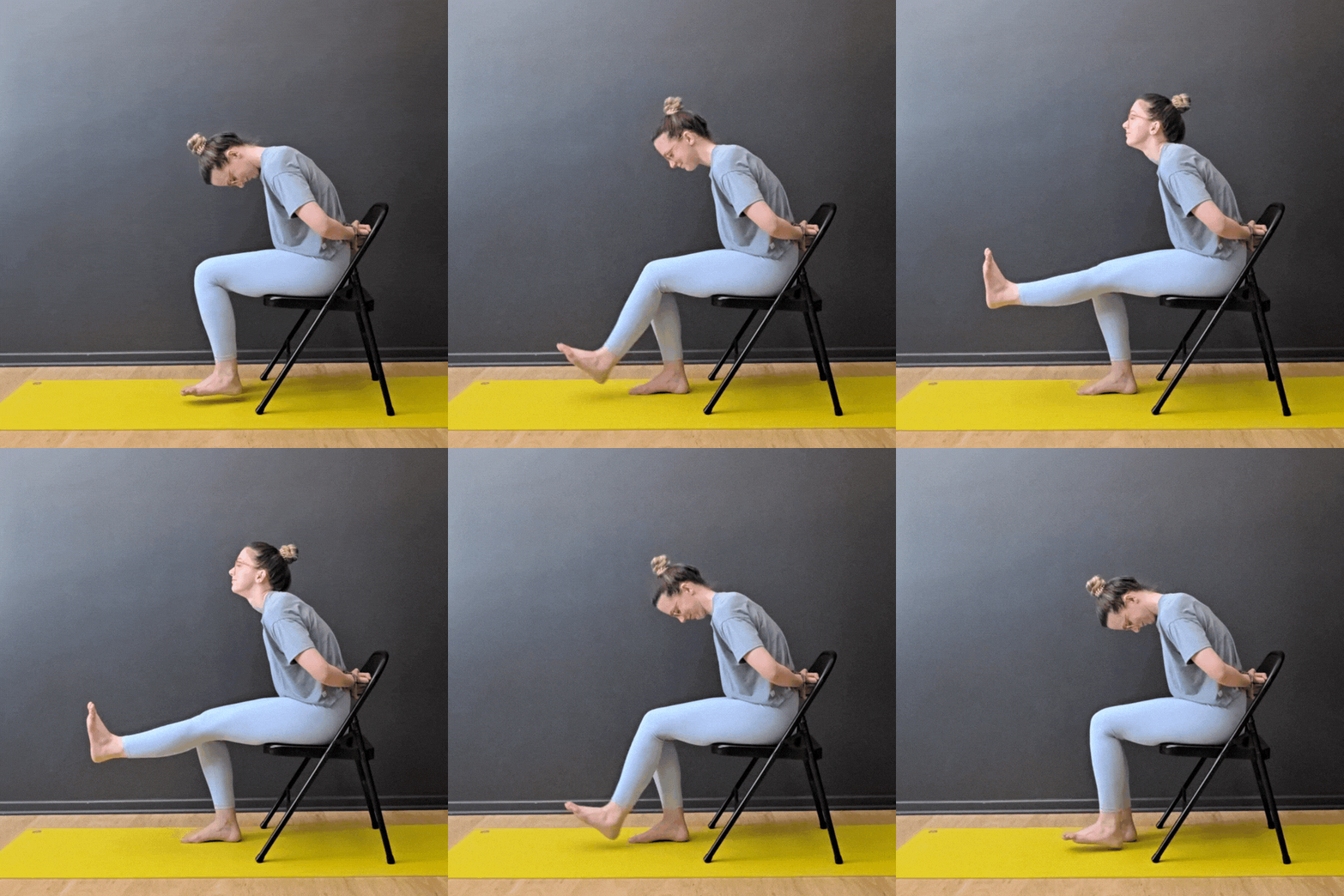
Start sitting in a chair with your hands crossed behind your back, feet flexed flat on the floor, and allow your body to slouch forwards (slightly rounding your upper back). Maintain this slightly rounded back posture throughout the drill
Let your head fall forwards to round your neck
Lift the foot and look up. Lift your head to look forwards (slightly arching your neck) as you start to straighten your right leg, lifting your (flexed) right foot until you feel a mild stretch. Only go until you feel a gentle stretch in the right calf, knee, or hamstring (it’s OK if the right leg does not straighten all the way). If you don’t feel any stretch at all, add a small amount of forward fold (or try the lying-down nerve glide instead)
Drop the foot and look down. Let the right foot fall back to the floor as you bend the knee and drop the head (rounding the neck)
Repeat for 10-15 reps of “lift the foot and look up” and “drop the foot and look down,” then switch legs
Choose Less Nerve-y Versions of Drills
Students with nerve tension should generally chose variations of drills that minimize tension in their nerve (while still getting an appropriate muscle stretch).
Our sciatic nerve essentially runs from our skull, down our spinal cord, out the backside of our hip, down the back of our leg, and underneath our heel to our toes (that is a simplified description, it does branch several other places, but for the purposes of this blog post that’s the “gist” of what we need to know).
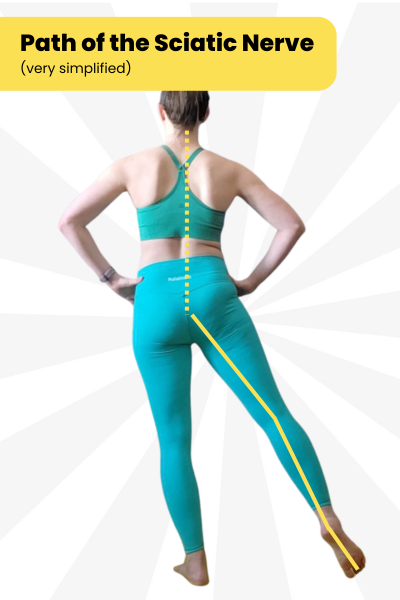
Because the sciatic nerve essentially runs down the backside of our body, positions where we are “shortening” the backbody help put it on a bit more slack, and positions where we are stretching and rounding the backbody put it under more tension:
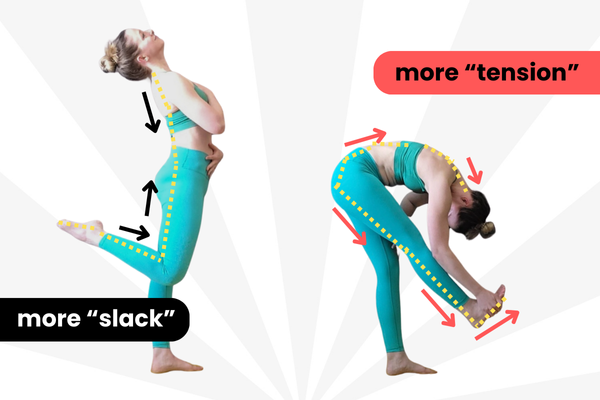
Now realistically we can’t do any hamstring stretches in the position like the photo on the left (because even though there isn’t any nerve tension, we are getting zero hamstring stretch). BUT we don’t want to do our hamstring stretches like that photo on the right because that is likely way too much tension. A “goldilocks” approach would be adjusting as much of our form as we can to keep a stretch in the hamstrings, but minimize the “stretch” on the nerve from some of the other joints (our back, neck, and ankles).
For hamstring stretches, that means we can:
flatten the back (vs. rounding the back)
point the feet (vs. flexing the feet)
slightly bend the knees (vs. stretching with perfectly straight legs) so long as you can still feel a stretch in the hamstrings, a knee bend is totally fine!
This is why I love back-lying hamstring stretches. They not only help us focus on our hamstring stretch (and help prevent rounding our back and unintentionally turning it more into a “back stretch”), they are also very easy to modify for students with nerve tension! It’s easy to keep the ankle relatively pointed, and bend the knees to modify the intensity of the stretch.
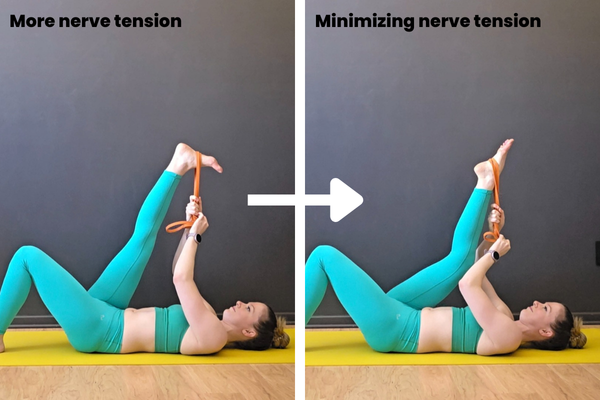
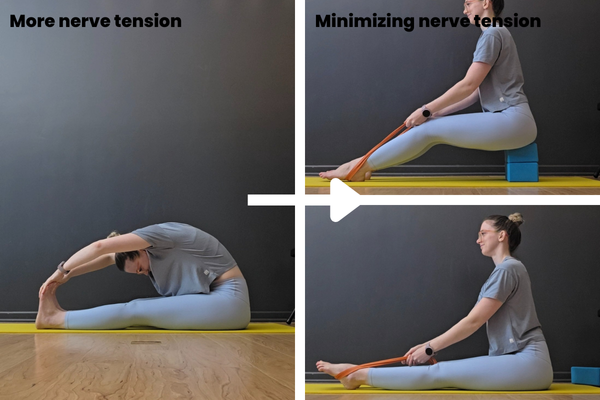
The “worst” possible stretch for someone with a high amount of sciatic nerve tension would be a seated forward fold with straight legs, feet flexed, rounding the back and neck to lean forwards, and grabbing on to the feet to pull the feet into a deeper calf stretch. This position could oo much tension on the sciatic nerve, possibly to the point of the body feeling like it’s “locking up” and refusing to let you stretch any deeper (as a protective mechanism). A safer-for-nerve-tension seated forward fold would involve keeping the back totally flat (which might mean elevating the hips on yoga blocks or in a chair to keep the back flat), pointing the feet forwards, and even potentially softening the knees, and using a strap to help pull you into the stretch. You can still get the same - or better - hamstring stretch with those modifications (even if it looks “less deep”), and it will be much gentler on your sciatic nerve.
That doesn’t necessarily mean you can never do rounded-back or feet-flexed forward folds - those are quite common in yoga so some students do want to be able to practice those safely - that just means you should try to keep those types of stretches *gentle* and not push them to the point of getting your usual nerve tension-y sensations.
I have a decent amount of sciatic nerve tension in both legs, so I always do nerve glides (and some other nerve drills) as part of my warm up. But on days where I have a lot of tension and those aren’t enough, I modify my stretches. If I’m in a yoga class, that means I keep my knees bent and heels lifted in downward dog, bend my knees a lot in ragdoll forward folds, and point my feet (and often bend my knees) in most other hamstring stretches (even if the instructor is cuing to flex the feet).
Relax! (Breathe)
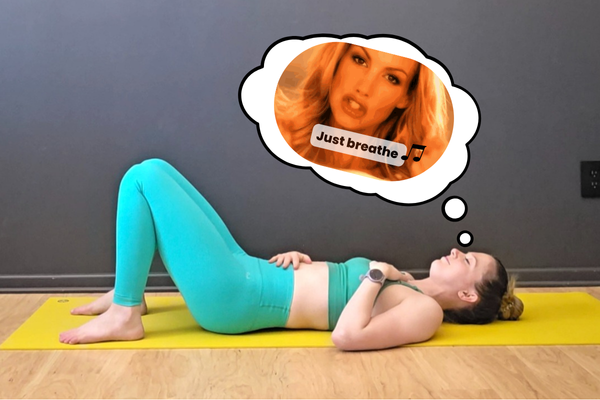
When we are stressed and our sympathetic nervous system (the “fight or flight” system) is up-regulated, this can increase nerve tension in our whole body. This is kind of like being tensed and “ready for action” in case you need to run away from that saber-toothed tiger (although rarely that extreme). That means if you are even mildly stressed about something (work, a relationship, just having a lot of stuff on your plate, a flare up of a chronic condition - shoutout to all my IBD bendy friends!), that may mean that you’ll have a harder time stretching if it ends up up-regulating that “fight or flight” stress response.
One thing that’s great to try in these situations to help down-regulate the sympathetic “fight or flight aaaaah it’s a tiger” response, and up-regulate the parasympathetic “rest and digest and chill TFO” nervous system is with breathwork or meditation. That could be as simple as spending one minute lying on your mat with your eyes closed, and taking some deep breaths. Or if you want to try an actual meditation or “formal” breathwork practice, try testing yourself for nerve tension right before and then right after your meditation and see if you notice a difference.
The InsightTimer app is free and has tooooons of guided meditations (including lots of 3-4 minute ones if you want something short) to try if you’re meditation-curious!
Will My Nerve Tension Go Away Eventually? (Long Term “Fixes”)
For the vast majority of students, nerve tension does lessen over time as the strength of your supporting muscles improves and our body can learn to adapt to safely tolerate slightly more tension over time. It may not go away completely, but if you are able to manage the symptoms of your nerve tension with nerve glides and form adjustments, then there’s no need to worry about trying to eliminate it completely if you can still stretch/train and perform your skills without “nerve-y” sensations holding you back. So the good news is - unless you have pretty intense nerve tension - you don’t have to permanently “get rid of it” to be able to make progress with your flexibility training.
Work on Your Active Flexibility
Active flexibility training - training where we work to strengthen the muscles that support holding us in stretched positions, as opposed to just trying to “relax” in a passive stretch - is helpful for anyone looking to increase their flexibility, but even moreso for folks with nerve tension. I’ve written before about recommendations for active drills for hamstring flexibility before, but here are a couple of examples of the types of drills I’d recommend folks with sciatic nerve tension try to incorporate into their training:
Strengthening Your “Stabilizers” (in Hips-Flexed Positions)
Even though we don’t generally rotate our thighs when doing “regular” forward folds or hamstring stretches, our hip rotators can help stabilize the hips and help our body feel “safe” in those positions to potentially stretch a little deeper. A great drill for this (from Dr. Jenn Crane (aka Cirque Physio), a super knowledgeable PT who I learned most of this neurodynamic stuff from) are banded windshield wipers.
Try 1-2 sets of these after your nerve glides and before your “deeper” hamstring-focused work and see if notice a difference!
Strengthening Your Hamstrings in their Lengthened Position
We want to make sure we can strengthen our hamstring muscles while they’re in that deepest-stretched position so that we can safely hold even deeper positions over time. If you have access to a gym, deadlift variations are great for this. But for folks who don’t have a gym, doing exercises like bodyweight good mornings or hamstring contract-relax are some of my favorites for this range of motion. Remember to keep the knees a little bent if you’re feeling those like a stretch in the calves.
Strengthening Your Quads & Hip Flexors in Their Shortened Position
The other category of muscles we want to focus on are the “helper” muscles that help pull is into a deeper hamstring stretch: our hip flexors and quads. Leg lift variations are my go-to drill for this type of strength. I do some variation of standing, sitting, or lying down leg lifts every time I work on my leg flexibility. These end range leg lifts are great for helping strengthen your hip flexors and quads while they’re already in a shortened position, which makes it even more challenging.
Looking For More Help?
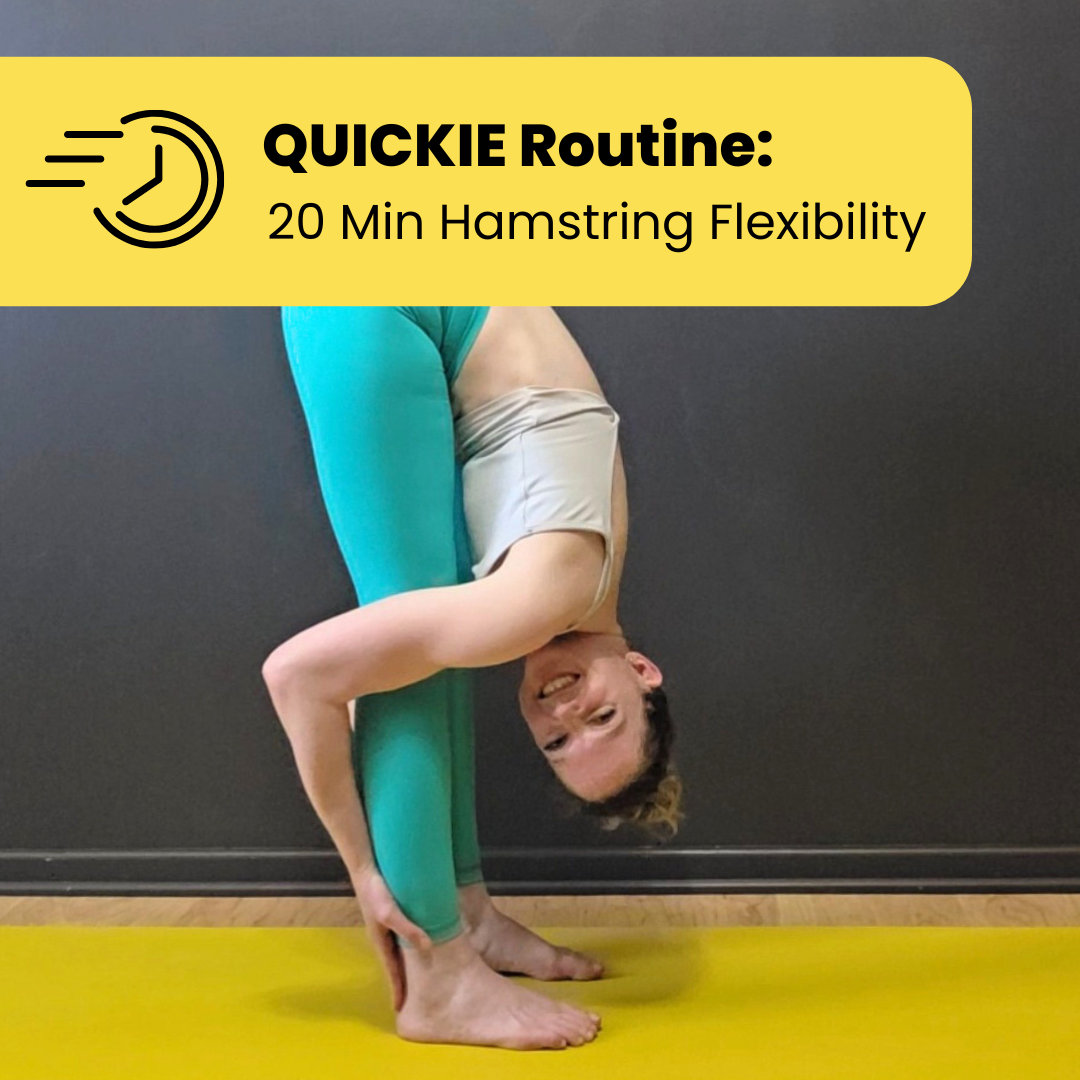
Get the 20-30 Min Nerve-Friendly Hamstring Flexibility Routine!
Who this routine is for:
This 20-30 minute training routine is targeted to students who want to work on their hamstring flexibility for deeper forward folds. Modifications of drills are given for all levels - whether you’re someone who’s working to finally be able to touch their toes, or whether you’re a more advanced student trying to get their belly all the way to their thighs in a forward fold, this workshop has drills for you!
What you get:
THIS IS NOT A FOLLOW-ALONG VIDEO like the majority of my other recordings. Instead, this is a written routine that includes detailed how-to videos for each drill, as well as educational content to help you maximize your progress in your hamstring-training journey.
This PDF includes:
Flexibility training best practices
Anatomical considerations for training hamstring flexibility
How to modify the drills to make them easier or harder as your flexibility progresses (spoiler alert: bending your knees is encouraged!)
How to test to see if you have nerve tension that will impact your training (and how to adjust accordingly)
Suggestions for training frequency
A program of drills with how-to videos explaining proper form, what sensations to look for, what muscles to engage (if needed), and how to modify to adjust the difficulty/intensity for each drill. The “default” routine is meant to fit a 20-minute training session
Additional recommended drills (along with how-to videos) for another 10 minutes of training for students who want to extend their practice to a 30-minute session
A printable all-on-one-page list of drills for quick reference
Heads up: Because each of the how-to videos is filmed as an educational video with comments on form, technique, and modifications - and not as a “follow along with me” style video, the videos will likely take longer to watch than to actually execute the exercise. So plan on your first run-through of this routine to take longer than 20 minutes because you’ll likely be watching the videos in their entirety which will take a bit longer (and then just skimming through them for reminders in the future).
Recommended props:
Yoga mat (knee padding is your friend!)
Some kind of long strap - can be stretchy or stiff
2 yoga blocks
A chair or bench (very helpful for folks with tight hips)
After a bunch of requests, I finally got a chance to record a short hamstring-focused flexibility routine. This 20-minute routine includes detailed how-to videos of each exercise, including what sensations to look for, how to modify to make the drills easier/harder depending on your flexibility level, and how to avoid “cheating” the exercise. I’ve also included additional recommended “bonus” exercises if you have time to extend your practice to a full 30 minutes.
Variations of drills are offered for all levels - both for folks with tight hamstrings who can’t (yet!) sit on the floor with their back flat, as well as variations for more advanced students who can comfortably get palms to the floor in a standing forward fold but want to be able to get their belly all the way to their thighs.
All of the drills can be easily adjusted to accomodate any potential nerve tension students may be experiencing (and these types of strengthening exercises are a great way to help reduce nerve tension over time).
When to See a Professional
Now if you’re trying everything in this post: incorporating nerve glides, form adjustments, and working on your active flexibility, but you’re still feeling limited by “nerve-y” sensations and not making any flexibility progress, then it may be worthwhile to make an appointment with a professional like a physical therapist (physio) or other professional. They can help better assess the root cause of your nerve tension and help prescribe more tailored drills to your specific use case. This could include things like massage, foam rolling or lacrosse ball-ing soft tissue, working on more tailored stretches to an area that might be “trapping” the nerve (the piriformis, one of the deep hip rotators, is a common culprit here), working on stabilizer muscle drills, mobilizations for the joint capsule itself, or prescribing different nerve-specific drills (ex. nerve “tensioners”) based on your needs. Dr. Jenn Crane (who I mentioned above as my biggest educational source on all things nerve-y) is a great PT who offers online appointments (availability may depend on what state you live in). Not all physical therapists are well versed in nerve tension, so if you are looking for a local PT or someone covered by your insurance, it may be worthwhile to reach out to them and check if they have experience with working with nerve tension before making an appointment.
But I hope that the information and tips in this blog post have helped you better understand how your body works, and armed you with some new tools you can use in your flexibility training to make more progress than you’ve ever seen before :)
Happy bending!
Related Content
Related On-Demand Workshop
Who this routine is for:
This 20-30 minute training routine is targeted to students who want to work on their hamstring flexibility for deeper forward folds. Modifications of drills are given for all levels - whether you’re someone who’s working to finally be able to touch their toes, or whether you’re a more advanced student trying to get their belly all the way to their thighs in a forward fold, this workshop has drills for you!
What you get:
THIS IS NOT A FOLLOW-ALONG VIDEO like the majority of my other recordings. Instead, this is a written routine that includes detailed how-to videos for each drill, as well as educational content to help you maximize your progress in your hamstring-training journey.
This PDF includes:
Flexibility training best practices
Anatomical considerations for training hamstring flexibility
How to modify the drills to make them easier or harder as your flexibility progresses (spoiler alert: bending your knees is encouraged!)
How to test to see if you have nerve tension that will impact your training (and how to adjust accordingly)
Suggestions for training frequency
A program of drills with how-to videos explaining proper form, what sensations to look for, what muscles to engage (if needed), and how to modify to adjust the difficulty/intensity for each drill. The “default” routine is meant to fit a 20-minute training session
Additional recommended drills (along with how-to videos) for another 10 minutes of training for students who want to extend their practice to a 30-minute session
A printable all-on-one-page list of drills for quick reference
Heads up: Because each of the how-to videos is filmed as an educational video with comments on form, technique, and modifications - and not as a “follow along with me” style video, the videos will likely take longer to watch than to actually execute the exercise. So plan on your first run-through of this routine to take longer than 20 minutes because you’ll likely be watching the videos in their entirety which will take a bit longer (and then just skimming through them for reminders in the future).
Recommended props:
Yoga mat (knee padding is your friend!)
Some kind of long strap - can be stretchy or stiff
2 yoga blocks
A chair or bench (very helpful for folks with tight hips)